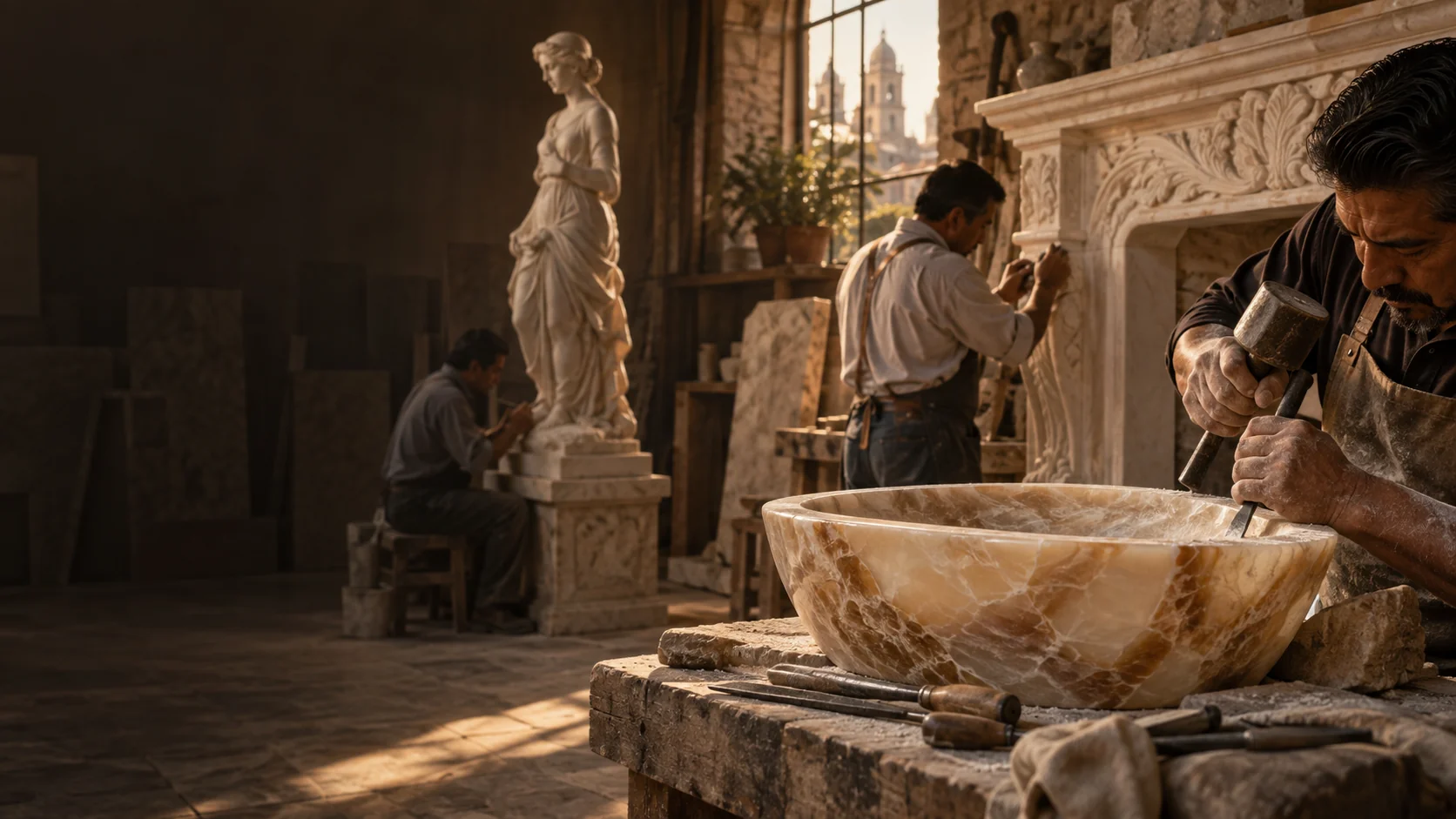
Masters of Stone · Puebla, Mexico
From stone block to architectural art
Enter the complete creative process—from artistic brief and material selection to carving, dry fitting, inspection and protected delivery.Architectural stone art is the meeting point of imagination, geology, proportion and disciplined handwork. A fireplace, fountain, sink, column, relief or sculpture may appear singular and effortless when finished, yet its creation depends on a chain of approvals and technical decisions. The artist must preserve the original intention while responding to a natural material that has its own grain, movement, strengths and limitations.
01 / Translate the vision into a working brief
The process begins by defining what the piece must express and how it must function in the final space. Reference images, architectural drawings, dimensions, viewing angles, finish, interior or exterior exposure, budget and schedule are organized into one brief. A sculptural object cannot be judged by beauty alone: clearances, water behavior, heat exposure, maintenance, code requirements and installation access may influence the design from the beginning.
02 / Select a material that supports the design
The stone is evaluated for color, movement, grain size, carving behavior, weather resistance, porosity and structural conditions. The block must be large enough for the design plus cutting and carving allowances. Veins and natural features are studied so they can become part of the composition without placing vulnerable areas at critical projections, thin sections or anchoring points. The best material is the one that supports both the artistic intention and the physical environment.
03 / Drawings, scale and approval
Concept sketches become dimensioned drawings, profiles, sections or digital models. For complex work, a clay model, carved sample, full-size pattern or three-dimensional scan may be used to confirm proportion. The client, designer, artisan and installer should agree on key dimensions, level of detail and finish before irreversible carving begins. Formal approvals protect the creative direction and prevent subjective expectations from changing after significant labor has been invested.
04 / Prepare and orient the block
The chosen block is photographed, measured and oriented according to the composition and the stone’s natural structure. Saws and diamond-wire equipment remove excess mass and create reference faces. Centerlines, profiles and control points are transferred to the stone. Correct orientation preserves critical depth and helps the artisan avoid placing open veins or weak areas where the finished form will be most delicate.
05 / Rough carving establishes the form
Large volumes are removed gradually with saws, pneumatic tools, points and chisels. The artisan works from major planes and silhouettes toward smaller forms, repeatedly checking measurements against drawings, patterns or the approved model. This stage determines proportion and balance. Removing too much material cannot be reversed, so speed must remain secondary to control and a clear understanding of the final geometry.
06 / Refinement, ornament and hand detail
As the form emerges, finer chisels, rasps, rotary tools and abrasives define moldings, facial features, leaves, lettering, textures and transitions. Tool marks may be intentionally preserved or progressively softened depending on the desired expression. Light and shadow become part of the design: depth, edge sharpness and surface direction determine whether detail remains legible at the intended viewing distance.
07 / Surface finish and protective strategy
The selected finish—carved, honed, polished, brushed, sanded or aged—is developed through controlled tooling and abrasives. Samples help establish the expected texture before the complete piece is finished. Cleaning methods and, when appropriate, compatible treatments are selected according to the material and exposure. A coating cannot correct unsuitable stone or poor drainage; protection begins with correct design and fabrication.
08 / Dry fitting, structure and quality control
Multi-piece work is assembled in the workshop whenever practical. Joints, profiles, transitions, plumbing passages, anchoring provisions and overall dimensions are checked before shipping. The review includes chips, unintended tool marks, repairs, finish consistency, component numbers and comparison with the approved design. Structural engineering and anchoring details should be provided by qualified professionals when the piece, site or code requires them.
09 / Custom packing, delivery and installation
Every component is photographed, labeled and supported according to its shape, weight and vulnerable details. Custom crates, foam, blocking and lifting instructions protect projecting elements and finished surfaces. The destination team receives assembly references, weights and handling information. Site access, foundations, wall conditions, equipment and installer responsibilities must be ready because a one-of-a-kind piece is difficult, slow and expensive to replace after avoidable transit or installation damage.
This educational article explains the standard industrial process. Exact machinery, treatment, inspection criteria and production sequence vary by material, supplier and project specification.
ARTISAN SELECTION · CREATIVE CONTROL · PROTECTED DELIVERY
OSO protects the distance between an original vision and the finished work.
Commissioning architectural art across borders is not the same as ordering a repeatable product from a catalog. The client is placing value in an idea that will be interpreted by a particular workshop, executed in a non-uniform natural material and transported as a piece that may never have an exact replacement. Misunderstanding can enter through the drawing, scale, stone, carving style, finish, anchoring, packing or installation. Because the work is custom, discovering that misunderstanding at the end can mean losing both the material and months of irreplaceable time.OSO Solutions International becomes the communication bridge between the client, designer, artisan, material source, logistics team and destination installer. The work begins by organizing the intention into practical information: visual references, dimensions, site conditions, finish, acceptable artistic interpretation, milestone approvals, schedule and delivery requirements. That shared brief gives every participant a common point of reference and makes subjective decisions easier to document.The right artisan is selected for the specific work—not simply because a workshop has an attractive portfolio. Different studios excel in classical ornament, contemporary forms, monumental sculpture, architectural components or detailed reproduction. OSO’s network helps connect the project with appropriate capabilities, confirm the workshop behind the proposal and coordinate the evidence a client needs before authorizing material or labor.During creation, OSO can organize progress documentation and approval milestones so proportion, detail and finish are reviewed before the piece is complete. Material identity, drawings, measurements, models, finish samples, dry-fit photographs and packing evidence can form a traceable project record. When a question or variation appears, the client has one contact who understands what was originally requested and can communicate with the correct participant without restarting the entire conversation.More than 25 years of market experience and international relationship building give OSO a network that would be extraordinarily difficult for a client to assemble for one commission. Finding a stone carver online is easy; knowing whether that artisan, supplier, packer or transporter is appropriate for this exact piece requires context earned through years of real projects, visits, problem solving and trust. OSO makes that experience available while protecting the client’s most limited asset: time.Art remains collaborative and natural stone remains variable, so no responsible coordinator can remove every creative or material uncertainty. OSO’s role is to reduce preventable surprises, preserve approvals, clarify responsibility and keep the artistic and technical sides of the commission connected. That discipline allows the client to enjoy the creation of something extraordinary without having to become an expert in every workshop, material and export process behind it.HOW OSO HELPS
- 01Creative-brief and project-requirement coordination
- 02Material and artisan capability sourcing
- 03Workshop and proposal verification
- 04Drawing, model, sample and milestone approvals
- 05Progress documentation and dimensional follow-up
- 06Dry-fit, finish and pre-shipment inspection coordination
- 07Custom packing, freight and installer communication
- 08One point of contact from concept to destination
EXPERIENCE
THE COST OF MISSING OVERSIGHT
What can compromise a one-of-a-kind stone commission?
Custom work concentrates value in material, skilled labor and time. A decision that might be corrected easily on a standard product can require a complete remake when the object is unique.An artisan is chosen from a portfolio that does not prove the right capability
A workshop may show beautiful finished projects while having limited experience with the required scale, style, stone, engineering or delivery conditions. Images can also represent collaborative work performed by another specialist. Confirming who will execute the piece, reviewing comparable details and understanding present capacity help prevent the commission from becoming an experiment at the client’s expense.
Carving begins before drawings and approvals are complete
If overall dimensions, profiles, ornament, viewing angle or degree of artistic interpretation remain unclear, each participant may imagine a different result. Once stone is removed, a proportion cannot simply be restored. Dimensioned drawings, samples or models and documented milestones reduce subjective disputes and give the artisan clear authority to proceed.
The selected stone cannot support the form or environment
A vein may pass through a projecting detail, a porous stone may be specified for a severe exterior exposure or a block may be too shallow for the intended relief. The problem might not become obvious until carving exposes the structure or installation exposes the piece to water and weather. Material selection must consider carving behavior and service conditions, not color alone.
The piece is beautiful—but does not fit the architecture
A fireplace surround can conflict with the firebox, a fountain can arrive without correct plumbing paths or a sculpture can exceed the access route and lifting capacity. Incorrect wall conditions, anchoring locations or finished-floor elevations can make installation unsafe or impossible. Field dimensions, interfaces and responsibility for site-specific engineering must be coordinated before fabrication is finalized.
The finish or detail differs from what the client imagined
Terms such as aged, hand carved, rustic or smooth are open to interpretation. Photographs can also hide scale, tool marks and surface variation. If finish samples and detail milestones are not reviewed, the first complete view may arrive after weeks of labor. At that point, changing the expression can damage the work or require substantial recarving.
A finished artwork is damaged, delayed or never delivered
Standard freight methods may not protect thin projections, separate components or polished faces. An unverified intermediary may collect payment without controlling the pickup, customs documents or final delivery. Custom crating, packing evidence, insured-carrier terms, tracking and clear custody are essential because replacing the piece may mean sourcing another block and repeating the entire creative process.
THE VALUE OF EXPERIENCE
Why OSO is an investment in the artwork, the schedule and the original intention.
The value at risk is larger than the artisan’s invoice. It includes selected stone, months of skilled labor, design fees, architectural coordination, custom packing, freight, lifting, installation and the emotional value of a piece created for a specific place. A dimension missed at the beginning or a detail misunderstood halfway through can cost more than the oversight that keeps those decisions visible.
A client attempting to manage the commission alone would need to locate and qualify artisans, understand regional stone, translate creative language into measurable approvals, monitor production, identify custom packers and coordinate international delivery. Developing that network through personal experience can take years, and the lesson learned from one failed custom piece cannot restore the lost schedule. OSO provides access to more than 25 years of market knowledge and established relationships without asking the client to build that system from nothing.
Choosing OSO means investing in continuity. The vision discussed at the beginning remains connected to the stone, the hands shaping it and the team receiving it. OSO cannot replace the artist, designer, engineer or installer; it helps those specialists work from the same information and gives the client one accountable communication path. That is how a complex international commission becomes easier to understand, supervise and bring home.
Create your architectural stone commission with OSO ↗